Local Energy Newshttp://www.localenergynews.org/news/en-US2025-05-01T18:15:02ZSquarespace V5 Site Server v5.13.594-SNAPSHOT-1 (http://www.squarespace.com)Stuck in the 1960's: Power Grid Evolution Remains Elusivehttp://www.localenergynews.org/news/2015/12/30/stuck-in-the-1960s-power-grid-evolution-remains-elusive.htmlMark Sardella2015-12-30T20:33:43ZNearly half of all electricity generated in the world today comes from power plants that use steam turbines built in the days of rotary telephones and manual typewriters, operating at thermal efficiencies of around thirty-percent and thereby discarding seventy percent of the energy in the fuel they consume.
How did the electric power industry miss out on the technological revolution of the past 50-years, and what can be done to bring the industry in-line with telecommunications, transportation, computing and countless other industries that have evolved so dramatically over the same time frame?
]]>Waldorf Commencement Addresshttp://www.localenergynews.org/news/2013/6/12/waldorf-commencement-address.htmlMark Sardella2013-06-13T06:11:08ZI was honored to give the commencement address to the Santa Fe Waldorf School's 2013 graduating class. The full text of my speech is here.
Kent Cravens, who resigned his post in the New Mexico Senate 2011 so that he could become the state’s top oil and gas lobbyist, assured the Senate Conservation Committee last month that hydraulic fracturing was safe, clean and necessary. Here are highlights of the rebuttal testimony he gave after I spoke on the dangers of hydraulic fracturing.
No Documented Cases of Contamination
“Just for the committee’s information, there’s not been a single documented groundwater contamination from fracking.
This is a favorite mantra of the industry, although they usually say there are no “proven” cases of contamination. (Watch the video to see Kent struggle to remember the agreed upon language.)
The statement is misleading for two reasons. First, proof is in the eye of the beholder. Outside of mathematics, things are rarely proven. The mountain of evidence correlating shale gas operations with water contamination will never convince the industry to admit that they are contaminating water. But any reasonable person, given the same evidence, can easily see it.
The second reason this statement is misleading is that it only addresses the fracking process, rather than from all the other processes that accompany fracking. This deception is expertly delivered by Lisa Jackson:
“I am not aware of any proven case where the fracking process itself has affected water…”.
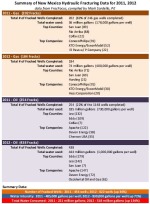
In New Mexico during 2011 and 2012, an estimated 3.7 million gallons of fracking chemicals were transported to well sites, pumped into wells at high pressure, pumped back out of the wells, transported to disposal sites, and then dumped – often underground. During this time, the industry self-reported nearly 1500 spill events, including 30 affecting waterways or groundwater and 17 involving fracking fluids. So, proven or not, the odds that water in New Mexico has not been contaminated by fracking fluid are essentially zero.
Coffee is a Chemical
“You know, chemicals are all over. A Styrofoam cup, a paper cup, coffee – everything has got a chemical structure to it. And so, when we say ‘chemicals’ we’ve got to just make sure we keep it in perspective."
So, chemicals are chemicals? Coffee and fracking fluid are on par with one another? It’s hard to imagine anyone making an argument so inane, let alone in testimony to a lawmaking body. Better yet, Energy Secretary John Bemis stood up right after this and had the nerve to assert that my presentation wasn’t academic enough, and that I needed to get better educated about fracking. Cream and sugar, Mr. Secretary?
The chemicals in fracking fluid are far more dangerous than those in coffee. Some are known to disrupt the endocrine system, which controls human development. For these chemicals, there is no safe dosage -- they are toxic in concentrations so small they must be measured in parts-per-billion. And yet, about five-thousand gallons are pumped down each and every fracked well.
Water Use is Insignificant
“Of the 4 million acre-feet of water consumed in New Mexico, 14,000 acre-feet in the last year were consumed by hydraulic fracturing. That’s less than four-tenths of one percent of the total water usage…”
When is water usage more than mere water usage? Answer: When you contaminate the water in a way that it can never be remediated, and then pump it underground into deep injection wells, removing it from the hydrological cycle. Comparing such “usage” to agricultural usage, in which clean water is used to nurture plants into food, is perverse at best.
Despite industry claims that they are moving away from using water for fracking, the data in New Mexico tell a different story. Reported water consumption by fracking operations more than doubled last year, from 221 million gallons in 2011 to 518 million gallons in 2012.
Induced Seismicity is a Fallacy
“…the idea that they can cause seismic activity – that’s been absolutely proven to be a fallacy.”
After hanging his hat on the impossibility of proving that fracking is contaminating groundwater, here Kent asserts that it has been “absolutely proven” that fracking doesn’t cause earthquakes. Evidently he hasn’t read the current issue of Mother Jones, which shows a correlation so strong that one seismologist commented, “You’d need Powerball odds for that to be a coincidence.”
Communities Want Fracking
“Oddly enough, there are counties out there that are really asking for us to help them craft ordinances that would support the creation of an industry in their counties.”
Odd indeed, especially if it were true. I never believe any claim that comes after the word "really." This one came in response to a senator asking whether local authorities had the ability to limit or prohibit hydraulic fracturing within their communities. There have been expensive and highly contentious battles all across the nation as communities struggle to find the legal means to keep out the destructive power of oil and gas. Santa Fe County, Mora County, San Miguel County and the City of Las Vegas, New Mexico have all waged such battles, with varying degrees of success. Passing our bill would have saved them all the trouble, while protecting the state's revenues by allowing fracking to continue in the two main basins where it is already occurring.
Conclusion
The only remaining question for me on the dangers of fracking is this: Do they know? If they do, and they are covering it up by playing stupid, would it constitute the greatest environmental crime in history? Sadly, I believe it would. Our planet is on the line this time. Really.
]]>Ban Hydraulic Fracturing in New Mexicohttp://www.localenergynews.org/news/2013/3/10/ban-hydraulic-fracturing-in-new-mexico.htmlMark Sardella2013-03-10T20:23:07ZA formatted copy of this post is available here. (PDF - 483kB)
Photo by Katherine Minott
I recently provided expert witness testimony to the New Mexico Senate Conservation Committee for a billto ban the spread of a controversial method of oil and gas extraction known as high-volume hydraulic fracturing, or "fracking."
New Mexico isstill highly reliant on revenues from its oil and gas operations, so the bill would have allowed hydraulic fracturing to continue in the two main shale basins where it is already occurring, while banning it throughout the rest of the state.
In my testimony, I cited five reasons to ban the spread of fracking in New Mexico:
Reason #1: Encroachment into Pristine Lands New Mexico’s oil and gas operations are primarily taking place in the Permian and San Juan Basins, located in the southeast and northwest corners of the state, respectively. But new regions of New Mexico, including our most pristine watersheds and agricultural lands, are beginning to open up to oil and gas production as a result of horizontal drilling and hydraulic fracturing technologies.
The encroachment of oil and gas operations into the center of the state poses significant risk to New Mexico's limited water supplies. Some of the chemicals being used for hydraulic fracturing are so toxic that even small releases in watersheds, reservoirs or rivers would inflict significant damage. The worst offenders are endocrine disruptors, for which there is no safe dosage. A few molecules present in a glass of water can be harmful, meaning that once water has been contaminated with an endocrine disrupting chemical, it cannot be reclaimed through purification.
Reason #2: Oilfield Spills On the Rise Spills in New Mexico’s oil and gas fields set records in 2012, with nearly 700 self-reported accidents over the course of the year, according to the online database of spills posted by the New Mexico Oil Conservation Division. Causes ranged from the mundane, such as trucks running over pipes and workers falling asleep while tanks overflowed, to the extreme, including well blowouts, casing ruptures and pipeline bursts. The 2.7 million gallons of hazardous materials reportedly spilled in 2012 is a small fraction of what was actually released, because many spills are entered into the database with a zero typed in the “amount spilled” column. Furthermore, many spill events may be going unreported. One compliance inspector I spoke with remarked, “If we hear about 10 percent of them, we’re good.”
At least 17 spills during 2011 involved fracking fluids, which contain the most dangerous of the chemicals in use. By the time one leak was repaired in Eddy County, New Mexico, more than 8000 gallons of hydrochloric acid, water and fracking chemicals had spilled from a tank and seeped down into the ground.
At least thirty reported spills during 2011 and 2012 impacted a waterway or groundwater supply. In one example, an equipment failure at a well pad in San Juan County allowed 15,000 gallons of crude oil and water to spill, sending a toxic flow into Lewis Park Canyon a few miles upstream from Navajo Lake State Park.
Groundwater can also be contaminated due to a failure of well casing integrity, which often goes unnoticed. Despite claims that multiple layers of steel and cement prevent hydrocarbons from migrating into fresh-water aquifers, several studies show that about six-percent of all new wells have poor casing integrity. And a study published in Oilfield Review shows that half of all oil and gas wells in the Gulf of Mexico lack casing integrity after 15 years.
Reason #3: A Growing Consumption of Fresh Water Data reported by industry to FracFocus show that usage of fresh water in New Mexico hydraulic fracturing operations more than doubled last year, rising from 221 million gallons in 2011 to 518 million gallons in 2012. The number of wells fracked grew 39 percent over that time, but the primary culprit is increased water usage per well, which rose from 485,000 per well in 2011 to more than 830,000 gallons the following year. If the trend continues, fracking in New Mexico will consume more than one-billion gallons of fresh water in 2013. Unlike water used in agriculture, the water consumed by fracking can never be reclaimed as drinking water, because it is first permanently contaminated by endocrine disrupting chemicals, and then it is pumped into deep injection wells, removing it from the hydrologic cycle.
Reason #4: A Frightening Contribution to Climate Change When methane (natural gas) is burned it emits carbon dioxide, contributing to climate change, but if the methane is released directly to the atmosphere without first being burned, the impact on climate is many times worse. Hydraulic fracturing has been shown to significantly increase direct releases of methane. When fracking fluids are withdrawn from the well after a frack job, the “flowback” contains a significant amount of methane, which is often vented rather than flared. Further, occurrences of methane bubbling up in freshwater streams after nearby fracking operations suggests that fracturing can open direct pathways from underground hydrocarbon reservoirs to the atmosphere. These releases could be a game-ender for our efforts to stabilize the climate.
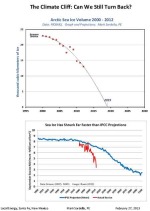
A straightforward calculation of reflected solar energy shows that the disappearance of summer ice in the Arctic will create a climate forcing roughly on par with the one humans created by burning fossil fuels. Estimating how long it will be before the summer Arctic ice is gone is also fairly straightforward, involving a simple forward projection of the ice-loss trend of the past ten years. My projection of the data suggests that the Arctic will be ice-free in the summer in 2019. On our current course, by 2020 the natural climate forcings will have surpassed the anthropogenic ones, and humankind will be powerless to stop the relentless onset of climate instability.
Reason #5: Risk of Continued Reliance on Oil and Gas New Mexico’s economy continues to be strongly dependent on oil and gas revenues. It is prudent, therefore, to undertake a realistic assessment of how stable these industries are, and to determine how long the resources might last. And, there is cause for concern.
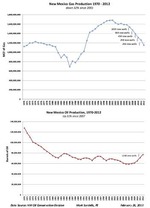
Gas production in New Mexico is down more than thirty percent since 2001, and the decline is certainly not for lack of drilling. More than a thousand new gas wells were brought online in 2007, and yet the amount of gas produced the following year fell by four percent. Another 856 new gas wells came online in 2008, and production fell once again – this time by more than five percent. Every year, even as hundreds of new gas wells were brought online, production continued to decline.
The decline of New Mexico gas production is not unexpected. With continued extraction, any finite resource will eventually go into decline. When drilling hundreds or even thousands of new wells each year fails to stem a decline in production, the resource is nearing its end days. It doesn't mean that the resource is running out – there is still plenty of gas underground. Rather, the effort required to find and produce the resource is rising to levels that cannot be sustained.
The rate of oil extraction in New Mexico, by contrast, is undergoing its most significant increase in fifty years. But it’s not because new “gusher wells” are being found, or vast, new reservoirs are being tapped. As a finite resource, oil is bound by the same laws of decline. The “easy” oil is long gone. Continuing to produce oil means drilling deeper, then drilling horizontally, and then injecting toxic chemicals at high volume and high pressure, requiring diesel-powered pumps rated tens-of-thousands of horsepower, just to coax a little oil out of the ground. Even with all that effort, fracked wells are exceptionally short-lived and must be re-fracked in a few years. The decline of oil can already be seen in the rising consequences of extracting it, and a decline in the extraction rate will soon follow.
I concluded my testimony with the following statement:
"In 1923, an engineer from Standard Oil convinced the U.S. Surgeon General that it was safe to blend a known neurotoxin with gasoline. Subsequent studies showed that 68 million American children were exposed to toxic lead levels and 325,000 Americans died from exposure to leaded gasoline.
In 1970, electric utilities convinced the U.S. Environmental Protection Agency that coal-fired power plants posed no threat to public health. Subsequent studies showed that particulate pollution from coal-fired power plants was killing 30,000 Americans annually. The current best estimate is still around 13,000 deaths per year.
In 2005, the oil and gas industry convinced Congress that slickwater, multi-stage hydraulic fracturing in horizontal wells is so safe that it should be exempt from enforcement under the Safe Drinking Water Act. What is unfolding in the wake of that deception is arguably the most serious public health threat ever perpetrated by the energy industry."
I'll post the responses to my testimony shortly. A video of the hearing is available here.
]]>Microgrids Paper Published by APEChttp://www.localenergynews.org/news/2013/1/19/microgrids-paper-published-by-apec.htmlMark Sardella2013-01-19T19:19:46ZThe paper I presented at the APEC Conference last October in Vladivostok, Russia has been published in the conference proceedings, and is now available online. The paper is about microgrids, which are electric power systems that have been decentralized to the point that they can stand alone from the larger power grid. You can download just my paper by clicking here, or download the entire proceedings by visiting this page.
I was proud to see my paper presented first in the proceedings. It makes sense, I think, because I gave a broad overview of microgrids as well as a strategy for helping them evolve. My thinking was that although it's important to understand the details of things like advanced microgrid control, we have not focused enough effort on laying a foundation on which the modernization of electric power can develop. In other words, it's nice to muse about what is possible and marvel about the wonders of dynamically islanding microgrids, but why the hell aren't they happening? How can we foster the evolution of the power industry, which seems stuck in the 1960's?
I hope you enjoy my paper! Photos of the conference are posted here.
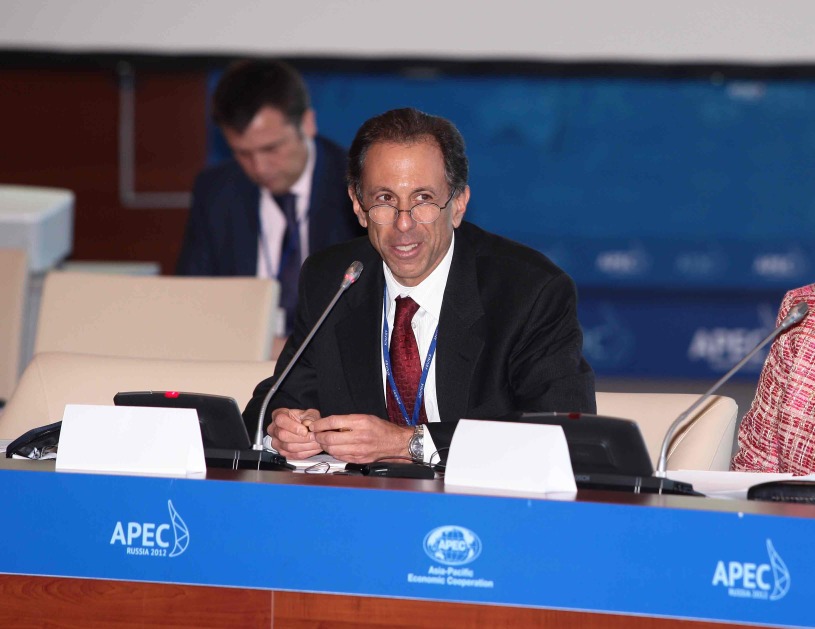
]]>Mark Sardella Speaks at APEC Meeting in Russiahttp://www.localenergynews.org/news/2012/10/25/mark-sardella-speaks-at-apec-meeting-in-russia.htmlMark Sardella2012-10-26T04:36:45ZAPEC Economics Electricity Policy microgrids vladivostokI just returned from Vladivostok, Russia, where I was an invited speaker at a workshop on power grid development in the Asia-Pacific region. The workshop, organized by the Asia-Pacific Economic Cooperation (APEC), focused on using microgrids to supply electricity to remote regions of the twenty-one APEC member countries. The meetings were chaired by Konstantin Ilkovsky, a member of the Russian Parliament, and attended by some of the Russian Federation’s top experts on energy, economics, and political science. China, Indonesia, Thailand, Philippines, Malaysia and Peru also sent governmental officials. No officials from the United States attended the meetings.
Microgrids are power grids that are powered by small, dispersed generators, energy storage systems and controllable loads. Often they are configured to automatically disconnect from other power grids and operate independently whenever it is beneficial to do so, such as when the other grid experiences an outage. This important step toward energy self-reliance is the reason Local Energy has long been advocating the breakup of the central power grid into microgrids.
While the overall APEC agenda of economic interdependence and free trade may be politically conservative, the workshop on microgrids evidenced a remarkably progressive agenda for infrastructure development. All of the APEC countries attending seemed determined to expand electricity delivery to remote regions absent the massive coal and nuclear power plants that are hallmarks of central power. A number of presentations focused on the technological considerations for building microgrid networks powered by small, distributed generators, but many others highlighted the sociological and ethical implications of electrification with a focus on meeting community needs and preserving cultural heritage.
For my presentation, I showed how good electricity policy could foster the development of a wide range of innovative technologies for the electricity industry, and how to set a foundation that encourages these technologies to connect strategically to the power grid. Specifically, I showed that given the right policies and regulations, the “system” of individuals and businesses developing and financing energy technologies will self-organize in ways that lead to an optimized electrical power network. Essentially, I showed the conditions under which complex systems take on adaptive and intelligent behaviors, and applied this basic systems theory it to the development of power networks. I am finishing a short report on the topic now, and will post it when finished.
In addition to inviting me to speak about my work at Local Energy, APEC invited four others from the United States: Larry Adams, a Senior Controls Engineer for Spirae, who is helping Denmark develop microgrid controls; Steven Pullins from Horizon Energy, who is developing strategies and technologies for decentralizing electrical networksworking for public and private clients around the world; Peter Lillianthal, who built a widely used software tool for designing microgrids; and Brad Reeve, General Manager of a small electrical cooperative in Alaska that is making great strides with wind energy. Additional presenters came from Korea, Japan, Chile, Australia and the Russian Federation.
]]>Tritium Detected in Santa Fe Wellshttp://www.localenergynews.org/news/2012/2/1/tritium-detected-in-santa-fe-wells.htmlMark Sardella2012-02-01T16:53:05ZBuckman LANL Policy Santa Fe Santa Fe Water nuclear tritium water
Is Santa Fe's drinking water safe?
More than half of our water in Santa Fe comes from the Rio Grande, and it's drawn downstream from Los Alamos Canyon regularly dumps toxic stormwater into the river. The rest comes from a wellfield that recently tested positive for radioactive tritium.
Watch the lecture, and decide for yourself!
]]>Comments on "The Risk at Buckman"http://www.localenergynews.org/news/2011/10/5/comments-on-the-risk-at-buckman.htmlMark Sardella2011-10-06T04:46:14ZI've received a lot of feedback from my previous article on Buckman, and learned a lot since then about what happened. The key to the "no risk" deception from ChemRisk was that they analyzed the river during "normal" flows when the toxin levels are low, rather than after rainstorms, when the toxin levels are very high. They also assumed that the electro-mechanical systems at Buckman would always sense the toxic flows and shut down the pumps, preventing toxins from entering the treatment systems. In other words, instead of doing the actual engineering risk analysis, they just assumed everything would be fine.
I got some very specific feedback from one LANL contractor who has a reputation for being an apologist for the lab, and I think the exchange is valuable so I've included it below. My comments are shown in blue.
Keep those cards and letters coming!
1.“…draws water from directly beneath several canyons that regularly dump storm water laced with radionuclides and bomb-making contaminants.” The Buckman diversion is located below only one major canyon---Los Alamos Canyon. Storm water is infrequent in that channel. Substantial flows (> 10-20 cfs) occur on the order of 5 to 10 days per year.
That is pure semantics: the three canyons converge just prior to dumping into the river. Flows following the recent fire have been very large and full of highly toxic ash, which is why all those news stories were done about them. Since storm intensities are generally growing, this will likely continue to be a problem.
2.“…below Los Alamos National Labs – host to more than 2,000 known toxic dumpsites?” This is a 20-year old number that the Lab came up with during the early days of the Environmental Restoration Program. It included known and rumored sites. After they field-checked the locations, many sites were dropped off the list (always done with approval of EPA). The current number is closer to 300, if my memory serves me. The vast majority of the sites are located downstream of the Buckman Diversion point and are located many miles from the Rio Grande. In actuality, most of the contaminants carried in Los Alamos Canyon are traceable to just a handful of old sites.
This calls for a celebration...there are only THREE HUNDRED toxic dump sites at LANL! Anyway, my sources are standing behind the 2000 figure. I guess calling something a rumor doesn’t make it untrue.
3.….”the study concluded that there was “no risk” posed by drinking water from Buckman.” I reviewed the Preliminary Draft technical report and didn’t see this language. It would be unfortunate if they did use that language. In the document I reviewed, they were very careful to quantify risk rather than to attach qualitative labels.
The “no risk” language occurs in both the draft and final reports, in the executive summary and in the body, and in all the news articles following release of the reports. Unfortunate, indeed.
4.….”It’s one thing to practice engineering without a license, and it’s another to tell 100,000 uses of a water system that there is no health risk from drinking water taken from beneath a nuclear waste dump.” The article seems to imply that a proper risk assessment could not be conducted unless a PE licensed in New Mexico performed the study. Having been a part of many large risk assessment teams, my opinion is the most effective were those which were multi-disciplinary with toxicologists, health physicists, hydrologists, environmental analysts and engineers. To suggest that only engineers are relevant is shortsighted. Regarding engineers, the ChemRisk team included Ph.D. level engineers. Also, the author seems to be unaware that a detailed independent review of the Buckman treatment system was performed by Kerry Howe, PH.D, P.E.---a University of New Mexico Environmental Engineering professor--- before ChemRisk efforts were launched.
This goes to the heart of my concern. Hydrologists did the hydrology, toxicologists did the toxicology, but where is the engineering? Having engineers on the team is not the same as doing engineering. Anyway, engineers ARE the only relevant ones FOR THE PART OF THE STUDY THAT REQUIRES ENGINEERING. If engineering was done, what is the MTBF (mean time before failure) of the sensing equipment components? Of the cellular relay transmitters? Of the alarm relays and pump relays? Did Dr. Kerry Howe calculate those, or did he also assume as everyone else did that the electro-mechanical systems would always work and that toxic storm-water would never be drawn into the system? I suspect the latter.
5.…”ChemRisk bills itself as the “premier contractor in the U.S. for characterizing former nuclear weapons complex sites.” In other words, they have carried out millions of dollars worth of work on behalf of LANL and other weapons complexes.” My understanding is the ChemRisk’s work at LANL is done on behalf of the U.S. Centers for Disease Control and Prevention. CDC was asked by Congress to direct health assessments and dose reconstruction studies of the nuclear weapon sites to ensure the assessments were done independent of the Department of Energy.
Allow me to simplify: ChemRisk has a biggie-wiggie contract at the Lab, but the Buckman study was teenie-weenie. Would ChemRisk jeopardize the biggie-wiggie by saying something in the teenie weenie that pisses off the muckie-muckies? Not on your winkie-tinkie they wouldn't.
6.“Just about anyone can tell you that after you remove contaminants, there is no risk of contamination.” This really is the heart of the issue, which boils down to a sediment removal project. If you remove the sediment, you remove the bulk of most of the contaminants, including those from LANL. I am not aware of anything unique to “LANL contaminants” that make them more difficult to remove when compared to other contaminants in the environment.
The point is that several trivializing assumptions were made, making the study useless as a risk analysis. First, the study assumed the water entering wouldn't be highly contaminated despite the fact that sometimes the river is highly contaminated. Then they assumed the not-very-contaminated water would be properly decontaminated before anyone drinks it. That is NOT a risk analysis! A risk analysis would be a study of the probability that the highly contaminated water enters the system and isn't properly decontaminated before it flows into the public water supply. You actually need a calculator and a brain to do a risk analysis, you can't just assume the risks don't exist and then conclude that you are correct.
7.…”In other words, they analyzed the risk of contamination after the contaminants were removed.” The Preliminary Draft Report does quantify risk from ingestion and swimming in the Rio Grande before treatment.
No, the report quantifies risk from ingestion and swimming in the river when the toxins aren’t flowing. There is also no risk in standing on a train track, unless a train is coming.
…”I haven’t carried out my own analysis of the risk of LANL contaminants getting into Santa Fe’s drinking water and making people sick, but my guess is that over the long run it’s somewhere around 100 percent.” This is quite an assertion without any analysis.
And quite an easy assertion to make once you understand probability theory. The more times you engage in risky behavior, the higher the odds of getting hurt. Repeat it indefinitely, and the odds rise to 100 percent. In the case of Buckman, we plan to pump water out of an increasingly polluted river every day for the next fifty years or so. Saying there is no risk in that is a lie that will, I fear, have tragic consequences.
]]>The Risk at Buckmanhttp://www.localenergynews.org/news/2011/8/2/the-risk-at-buckman.htmlMark Sardella2011-08-03T04:22:37ZBuckman Diversion LANL nuclear water Commentary Santa Fe WaterSanta Fe recently brought online a new system that takes water out of the Rio Grande to supplement it's municipal drinking water. Unfortunately the new system, called the Buckman Direct Diversion, draws water from directly beneath several canyons that regularly dump storm water laced with radionuclides and other bomb-making contaminants.
What on earth would prompt Santa Fe officials to draw municipal drinking water from below the Los Alamos National Labs – host to more than 2,000 known toxic dumpsites? You might ask them. Seriously, if you are concerned you should attend their Board Meeting this Thursday (City Hall, 4:00p), where you can ask them directly. If you can't make the meeting, you can always call or email them.
Consuelo Bokum bokatz@cybermason.com 505-982-4342 Chris Calvert ccalvert@santafenm.gov 505-955-6812 Danny Mayfield dmayfield@santafecounty.org 505-986-6200 Rosemary Romero r2romero@santafenm.gov 505-690-3016 Liz Stefanics lstefanics@co.santa-fe.nm.us 505-986-6210 Virginia Vigil vvigil@co.santa-fe.nm.us 505-955-2755 Rebecca Wurzburger rebeccawurzburger@gmail.com 505-955-6815
They will tell you that they commissioned a studyto look at the risk to Santa Fe residents, and the study concluded that there was “no health risk” posed by drinking water from Buckman.
No health risk? None?
Here’s are a few things you should know about the risk analysis.
First, there is no such thing as a system with “no risk.” Everything has risk, and when it comes to engineered systems, history is rife with examples of engineers under-predicting risk. I pointed this out in a letter to the Santa Fe New Mexican last November, and surprisingly I got a call the next day from an investigator from the New Mexico Board of Registration for Professional Engineers. He reminded me that when I became licensed as an engineer in New Mexico, I agreed to abide by a Code of Professional Conduct that includes reporting substandard engineering practice that might effect public safety.
So last November, I filed a formal complaint against ChemRisk – the company that did the risk analysis. The investigator, Roman Garcia, told me that no ChemRisk employees could be found on the roles of licensed engineers in New Mexico.
It’s one thing to practice engineering without a license, and it’s another to tell 100,000 users of a water system that there is no health risk from drinking water taken from beneath a nuclear waste dump.
The results of ChemRisk’s report were released in draft form in October, 2010 after Santa Fe had already spent more than $200 million on the Buckman project. ChemRisk charged $200,000 for the analysis -- about one-tenth of one percent of the project cost. Seems like that might have been a good investment to make before the start of the project, rather than after it’s completion.
On it’s website, ChemRisk bills itself as the “premier contractor in the U.S for characterizing former nuclear weapons complex sites.” In other words, they have carried out millions of dollars worth of work on behalf of LANL and other weapons complexes. Are they willing to jeopardize those contracts in favor of a little $200,000 contract for Santa Fe? This is commonly known as an “inherent conflict of interest”.
ChemRisk’s integrity has been questioned before. In 1997, the Wall Street Journal reported that ChemRisk “reanalyzed” data from another scientist and published their work in a scientific journal, under the original scientist’s byline, reversing the conclusion that chromium contamination in drinking water leads to an increased risk of stomach cancer. ChemRisk didn’t mention that the work was paid for by PG&E, who was working at the time on the infamous Erin Brockovich case. PG&E paid $333 million to settle the Brokovich case, and the scientific journal retracted the article.
Did ChemRisk’s do anything unethical when they analyzed the Buckman data? In my opinion they did, but they may have gotten some help from the Buckman Board. Buried in ChemRisk's report is an assumption that four of the most dangerous contaminants known to wash into the Rio Grande above Buckman are removed before anyone drinks the water. In other words, they analyzed the risk of contamination after the contaminants were removed, allowing them to state that there is “no health risk”.
Just about anyone can tell you that after you remove contaminants, there is no risk of contamination. You don’t need to spend $200,000 to find that out.
An article published in the Santa Fe New Mexican last December claims that the decision to study the risk of contamination under the assumption that contaminants had been removed was made by the Buckman board of directors. That would be shocking if it turns out to be true. Perhaps we should ask them.
I haven’t carried out my own analysis of the risk of LANL contamination getting into Santa Fe’s drinking water and making people sick, but my guess is that over the long run it's somewhere around 100 percent. My reasoning is this: If you put one bullet in a six-shooter, spin the cylinder, point the barrel at your head and pull the trigger, the odds of killing yourself are just one in six. But it is a well established fact that if you repeat the game over and over again, day after day, you will surely kill yourself. It is a mathematical certainty.
As long as the Buckman pumps continue to run and the LANL toxins continue to flow, Santa Feans are playing a perpetual game of Russian Roulette with their drinking water. Unless LANL cleans their waste out of the canyons above Buckman, eventually our water supply will become toxic.
It is, sadly, a mathematical certainty.
]]>The Problem with Carbon Capshttp://www.localenergynews.org/news/2011/8/1/the-problem-with-carbon-caps.htmlMark Sardella2011-08-01T14:14:53ZElectricity Policy Santa FeA friend wrote to me this morning with a simple question about New Energy Economy's ongoing fight for carbon caps on electric utilities. Here is my response.
The problem with setting a cap and creating a market for carbon is that there are too many loopholes, leaving too much room for the same shenanigans we’ve always seen from utilities. Utilities are loophole specialists. They are only fighting this fight out of instinct, and because they love it when their very, very highly paid lawyers can be reimbursed by ratepayers. ;o) A colleague of mine affectionately calls this "paying for the stick they beat us with". Nice!
Here are some of the specific problems with a law mandating that utilities reduce carbon emissions:
Electric utilities... ...want to go nuclear anyway, and everyone seems to think that nukes are carbon-free. ...pass their costs on to ratepayers on everything they do, no matter how stupid. ...are prepared to game the carbon market, just like they game every market they are given.
There are many avenues for addressing the horror that is the electric utility industry, including...
...separating genco’s from disco’s/transco’s (no company can own both wires and generators). ...granting citizens a right-of-access for uploading energy to the grid (currently we can only download). ...applying feed-in tariffs that reward strategic implementation of distributed generation. ...mandating a fuel-to-wire efficiency standard that increases over time.
The last one (the efficiency standard) is interesting to me, and I’ve never heard it proposed. It’s easy to implement and track, and it would expose the insane inefficiency of the central generation model (the main reason utilities pollute so heavily). It would also yield immediate carbon reductions, and there is precedent (automobile fuel standards).
But the real solutions are so boring...I can hear the yawns out there already.
Think I’ll head back into my stupor now! Much love, - Mark
 Nearly half of all electricity generated in the world today comes from power plants that use steam turbines built in the days of rotary telephones and manual typewriters, operating at thermal efficiencies of around thirty-percent and thereby discarding seventy percent of the energy in the fuel they consume.
;)
;)
;)
;)